Wednesday, July 21, 2010

Steve Earle: N. Y. C.

SONG N. Y. C.

WRITTEN BY Steve Earle

PERFORMED BY Steve Earle

APPEARS ON El Corazon (1997)

NOTE 1 The cover art is by the Chicago artist Tony Fitzpatrick. 2 That's  Buddy Miller playing lead guitar in the video.

"N. Y. C." stands as one Steve Earle's top rockers and most requested songs. It tells the story of a middle-aged, somewhat disillusioned man who gives a ride to Billy, a young and hopeful hitchhiker who wants to try his luck in New York City. After all, if you can make it there, you can make it anywhere, right?  Billy relates his adventures to a rueful, half envious listener, and summarizes his impression of all that New York has to offer in these words:
I heard the girls are pretty
There must be something happening there
It's just too big a town
The dual allure of sex and boundless opportunity being what it is, Billy shouldered his guitar, put his thumb in the wind, set out uncomplainingly through "a thousand miles of sleet and snow and rain."

The older man is skeptical, but keeps it to himself. He tried New York once, but struck out in a week. The girls, who by now represent opportunity itself, "wouldn't talk to me." Thus, Earle establishes a tension between youthful exuberance and optimism v. experience and disillusion. Look, the older man reasons to himself, at what Billy will go through just to take a shot at making it in the Big Apple. Coldness, dampness, and hunger are nothing in comparison; and very possibly disillusion is a fair price to pay for the paradoxical experience of youth.

So, the driver "slips the kid a twenty" because maybe -- just maybe -- Billy will be one who makes it, and the twenty will play apart. And no matter what, Billy is twenty dollars further down a meaningful road already filled with "a hundred stories."
LYRICS
He was standing on the highway
Somewhere way out in the sticks
Guitar across his shoulder
Like a thirty ought six
He was staring in my headlights
When I came around the bend
Climbed up on my shotgun side
And told me with a grim

I'm going to New York City
I've never really been there
Just like the way it sounds
I heard the girls are pretty
There must be something happening there
It's just too big a town

He was cold and wet and hungry
But he never did complain
Said he'd come a thousand miles
Through sleet and snow and rain
He had a hundred stories
About the places that he'd been
He'd hang around a little while
And hit the road again

I'm going to New York City
I've never really been there
Just like the way it sounds
I heard the girls are pretty
There must be something happening there
It's just too big a town

See I've been to New York City
Just like it was yesterday
Standing like a pilgrim
On the Great White Way
The girls were really pretty
But they wouldn't talk to me
I held out about a week
Went back to Tennessee

So I thought I'd better warn him
As he climbed out of my car
Grabbed his battered suitcase
And shouldered his guitar
I knew I was just jealous
If I didn't wish him well
I slipped the kid a twenty
Said "Billy give 'em hell"

I'm going to New York City
I've never really been there
Just like the way it sounds
I heard the girls are pretty
There must be something happening there
It's just too big a town
Wednesday, July 14, 2010

The Marshall Tucker Band: 24 Hours At A Time

SONG 24 Hours At A Time

WRITTEN BY Toy Caldwell

PERFORMED BY The Marshall Tucker Band

APPEARS ON A New Life (1974); Where We All Belong (1974); Stompin' Room Only [live] (2003); Anthology: The First Thirty Years (2005)

NOTE The lyrics are from the original studio version of "24 Hours." MTB altered them somewhat in performance.

The Marshall Tucker Band sang about men and women, not boys and girls. This conferred a sense of maturity and sexual awareness onto their college-aged fans, a sensibility that may or may not have been merited, but that was nonetheless appreciated, by a group that saw itself on the back end of coming of age. The band offered an arguably a maturing sound as well: Toy Caldwell's heroics met the needs of any dorm room air guitarist, while a subtle blend of rock, country, and jazz appealed to developing tastes in a way that, say, Lynyrd Skynyrd's testosterone drenched thunder could not. (Which isn't to say that Skynyrd was not a great band: In the southern rock pantheon, they're second only to the Allman Brothers.)

In "24 Hours at a Time," the singer drives headlong toward a relationship, as fast as legally permitted ("I've got this ride doin' 70 miles an hour").  The national speed limit was 70 mph when Toy Caldwell wrote "24 Hours," although there may be a nod to the pending change to 55 mph, which would slow his approach to the woman who is "always on my mind/24 hours at a time."

In any case, "24 Hours" attempts to balance out songs like "Gentle On Mind," in which the male singer expresses appreciation for a woman precisely she'll always be there no matter how much he strays and rambles. In "24 Hours," by contrast, the road is an inconvenience, something to disposed of as quickly as possible no matter how far the singer has come ("I've been drivin' about six hours") or how near the destination ("Texarkana's an hour ahead/And I've got to keep my wheels rollin'"). He's heading toward, he hopes, someone who loves him, and the romance of the road is a barrier.

For in the end, the singer drives toward hope ("I'm hopin' you feel the same way"), and that's the emotion most educed by the extended jam between Caldwell, Jerry Eubanks (tenor sax), and Charlie Daniels (fiddle), an improvisation that restates the journey musically and the reasons behind it. The end of the jam leads not to a reprise of the driving chorus, as one might expect, but a repetition of the singer's desire that she "feel the same way." We want that, too.

LYRICS
I've been down around Houston, Texas
Where the sun shines most of the time
I've been drivin' about six hours
Tryin' to reach that Arkansas line

But Texarkana's an hour ahead
And I've got to keep my wheels rollin'

But woman you're always on my mind
24 hours at a time
So my woman I'm hopin' you feel the same way

Woman, you know that I miss you
'Til I can't miss you no more
I've got this ride doin 70 miles an hour
She's loaded, she's down to the floor

But I've got to reach that Arkansas line
Before the sun goes down

But woman you're always on my mind
24 hours at a time
So my woman I'm hopin' you feel the same way

Woman you know I need you
I've been on the road too much
Tired of lookin' at the highway
Got to keep in touch some way

I've been down around Houston, Texas
Where the sun shines most of the time
I've been drivin' about six hours
Tryin' to reach that Arkansas line

But Texarkana's an hour ahead
And I've got to keep my wheels rollin'

But woman you're always on my mind
24 hours at a time
So my woman I'm hopin' you feel the same way

Feel the same way...


The studio version, from the album A New Life:

Thursday, July 8, 2010

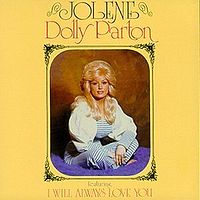
Dolly Parton: Jolene

SONG Jolene

WRITTEN BY Dolly Parton

PERFORMED BY Dolly Parton

APPEARS ON Jolene (1973); The Essential Dolly Parton (2005); The Ultimate Dolly Parton; many others.

NOTE 1 "Jolene" is an essential Dolly Parton song. Any anthology without it is by definition incomplete. 2 The White Stripes' epic performance of "Jolene" appears on their album Under Great White Northern Lights.

Alarmed by the attention paid by her husband to a sexy bank teller and charmed by the name of a fan, Dolly Parton combined the two and wrote a classic country ballad of sexual envy and despair. Though lyrically simple on the surface, "Jolene" evokes a swirl of competing emotions that, though addressed exclusively to the eponymous temptress, raises question after question about the nature of the singer's devotion to her husband and indeed about her own state of mind.

Parton gets down to brass tacks immediately, invoking her rival's name repeatedly before casting off any pretense of pride to beg for mercy. She commingles flattery and abject submission, lauding Jolene's many physical attributes before admitting that "I cannot compete with you" and that Jolene could "easily take my man." Parton admits that her man dreams of Jolene and not her ("He talks about you in his sleep") and then comes out and says it: "My happiness depends on you." One wonders whether Parton takes a terrible risk by being so brutally frank: Might she not be tempting Jolene to aim her erotic power at Parton's man?

In any case, Parton lets us into the soul of a troubled and lost woman whose happiness depends on Jolene, on her man -- on anyone but herself. She has so lost control of her own life that she's willing to humiliate herself before a younger woman for the sake of a man who may be preoccupied with that woman. Indeed, that's all we really know about the husband, save that for some reason Parton believes "he's the only one for me."

Indeed, in many ways, "Jolene" is as interesting for what Parton leaves unsaid as for what she reveals. She absolves her husband of any complicity in the triangle, presumably because he could not possibly resist Jolene's siren song. Is it because men are that weak? Or has he strayed before, but Parton fears that this time he won't return? Why does Parton believe that Jolene's allure will overwhelm the substance of a relationship? Possibly, the relationship has faded or become loveless and routine, but she doesn't want to leave something that has its own comforts and because she fears that, whoever she is with, there will always be another Jolene.

Although she sings that "you don't know what he means to me," she never explains what just what he does mean to her. She's inviting us to fill in the blank with out our own experience, but it may also be that she can't recognize her own jealousy and possessiveness. We don't know what she means to him, either, although he comes across as aloof and easily led astray. Why would an emotionally healthy woman need such a man in her life?

In the end, the singer emerges as a troubled person whose life has become absorbed into that of her husband's, fears losing it and him, and can do nothing but beg mercy of the force seemingly bent on destroying her. In this regard, "Jolene" serves as a cautionary tale reminding us "to thine own self be true," because when push comes to shove, you don't want to jump only to find that Jolene holds the net.

LYRICS
Jolene, Jolene, Jolene, Jolene
I'm begging you please don't take my man
Jolene, Jolene, Jolene, Jolene
Please don't take him just because you can

Your beauty is beyond compare
With flaming locks of auburn hair
With ivory skin and eyes of emerald green
Your voice is like soft summer rain,
And I cannot compete with you Jolene

He talks about you in his sleep
There's nothing I can do to keep
From crying when I hear your name, Jolene

And I can easily understand
How you could easily take my man
But you don't know what he means to me, Jolene

Jolene, Jolene, Jolene, Jolene
I'm begging you please don't take my man
Jolene, Jolene, Jolene, Jolene
Please don't take him just because you can

You could have your choice of men
But I could never love again
He's the only one for me, Jolene

I had to have this talk with you
My happiness depends on you
And whatever you decide to do, Jolene

Jolene, Jolene, Jolene, Jolene
I'm begging you please don't take my man
Jolene, Jolene, Jolene, Jolene
Please don't take him just because you can
Jolene, Jolene


The White Stripes bring post-millenial angst to Parton's lyrics; the enthusiastic crowd demonstrates the crossover appeal of Parton's lyrics and the universality of her theme:

Tuesday, June 29, 2010

Andrew Combs: Tennessee Time

SONG Tennessee Time


WRITTEN BY Andrew Combs


PERFORMED BY Andrew Combs


APPEARS ON Tennessee Time (2010)


Exile and longing comprise one of country music's most enduring themes. While its Biblical roots resonate with the rural Christianity that formed country's original fan base, its popularity as a theme likely stems from the origins of radio and the diaspora of rural Americans that began with the Industrial Revolution and accelerated through the Great Depression and World War II. The Dust Bowl, the military draft, and the migration to high paying urban manufacturing jobs must have created a profound sense of dislocation for the young men and families suddenly far removed from everything they knew. Songs celebrating the simple, lost joys of rural life emerged, and, dispersed across radio waves, soon formed a vital part of the country music canon.


Newcomer Andrew Combs captures this sense of longing and belonging in "Tennessee Time," a sensation amplified in the wonderful video below. The first time I heard "Tennessee Time," I immediately thought that it would  make a great front porch song. The notion wasn't original; as it turned out, Combs thought so, too (see the wonderfully sweet video  below). In "Tennessee Time" the singer has returned home from a European tour that took him from Spain to Ireland, only to discover that "there ain’t nothing better/Than the Tennessee life."


Which is fine with him: The song is all about creating epiphanies that allow him to be "stuck in the moment of Tennessee time." Thus in the first verse, he gathers southern icons like sweet tea and a rocking chair, and repairs to the porch to sing "old country songs to the passerby." It's a moment where fast songs and sad lyrics make sense in the ineffable ambience of a Tennessee porch, and where a spiritual connection occurs in the "summers near the Cumberland Gap...stuck in a moment of Tennessee time."


Combs, who sounds like a fusion of Slaid Cleaves and Gram Parsons, names Guy Clark, Willie Nelson, Townes Van Zandt, and Hank Williams as influences. Estimable mentors all, but the trick lies in finding his own voice via the path they lay. He's off to an impressive start.


LYRICS
I bought myself a little old rocking chair
Got a cup of
sweet tea, gonna sit right here
Singing old country songs to the passerby
Just stuck in the moment of Tennessee time

Spring brings green and a love so sweet
My heart tends to flutter and skip a beat
Me and my baby, we’re out of our minds
Stuck in the moment of Tennessee time


Chorus
I’ve been known to roam
I’ve been to Spain
I’ve been out in the Galway rain
I’ve come so close
To what I thought was right
But there ain’t nothing better
Than the Tennessee life

I play a little guitar in a rock n’ roll band
We sing sad songs and play as fast as we can
The drums are loud and the words don’t rhyme
But we’re keeping good rhythm to the Tennessee time

Now I spend my summers near the Cumberland Gap 

I sleep outside, with the grass at my back
Just roll cigarettes, drink whiskey from rye
Still stuck in the moment of Tennessee Time 


Thursday, June 24, 2010

John Prine: Sabu Visits the Twin Cities Alone

SONG Sabu Visits the Twin Cities Alone

WRITTEN BY John Prine

PERFORMED BY John Prine

APPEARS ON Bruised Orange (1978); Live (1988); Great Days: The John Prine Anthology (1993)

By the time John Prine wrote "Sabu" in 1978, he must have feared that, regardless of the quality of his future work, his eponymous first album would define his reputation. Prine needn't have worried. Although fans still want to hear him sing "Angel From Montgomery," they go to his concerts to see him perform for a body of work that spans a distinguished 40-year career. Early on, though, Prine found parallels between his own experience and that of an Indian child movie star.

In 1937, while shooting on location in India, famed documentary film maker Robert Flaherty cast a 13-year old boy named  Sabu Dastigir (or Selar Shaik Sabu or Sabu Francis) into a film called Elephant Boy. His name shortened to Sabu, the boy went on to a modest film career highlighted by starring roles in The Thief of Baghdad (1940) and Jungle Book (1942). After becoming an American citizen in 1944, Sabu joined the Air Force and won a Distinguished Flying Cross for service as a tail gunner in the Pacific theater. After World War II, Sabu attempted to restart his film career, but met with only modest success. His last film, the Disney thriller A Tiger Walks, was released shortly after his death from a heart attack in 1963. Sabu made 22 movies between 1937 and 1964, including such forgettable titles as White Savage, Cobra Woman, Man-Eater of Kumaon, Savage Drums, and Jungle Hell.

In "Sabu Visits the Twin Cities Alone," John Prine reimagines the post-war days of Sabu's career as a parable of the the pitfalls of peaking too soon and hanging on too long. By dropping his Indian protagonist into St. Paul, Prine achieves a sense of dislocation that haunts the song. Faced with a dwindling audience and a disinterested producer, Sabu gamely makes his way through the midwest while a sympathetic manager hopes that the numbers on a phone will materialize into a better box office and contemplates the end of his client's career.

No matter: Sabu may be "sad, the whole tour stunk," but he "must tour or forever rest." No doubt this refers to Prine's own struggles as an up-and-coming musician and the eternal challenge of keeping an audience. Did Prine fear that his best work was already behind him, that he had a future filled with cobra women, man-eaters, and albums that weren't "really doing so hot"? Had his ambition driven him to a lonely, peripatetic life infuseed by a numbing indifference (the "wind chill factor")? Possibly. But with characteristic bravado, Prine can't resist a few wry, bitter jokes at his own expense:
the airlines lost the elephant's trunk
the roadie got the rabies and the scabies and the flu
Sometimes, the only thing to do is laugh, hope for the best, and press on.
LYRICS
The movie wasn't really doing so hot
said the new producer to the old big shot
its dying on the edge of the great Midwest
Sabu must tour or forever rest.

Hey look ma
here comes the elephant boy
bundled all up in his corduroy
headed down south towards Illinois
from the jungles of East St. Paul.

His manager sat in the office alone
staring at the numbers on the telephone
wondering how a man could send a child actor
to visit in the land of the wind chill factor.
Sabu was sad the whole tour stunk
the airlines lost the elephant's trunk
the roadie got the rabies and the scabies and the flu
they was low on morale but they was high on.


"Angel From Montgomery," Prine's most beloved song, has been covered by Bonnie Raitt, Susan Tedeschi, and others:

Tuesday, June 15, 2010

The Flaming Lips: "Waitin' For a Superman"


Song: "Waitin' For a Superman"

Written by: Wayne Coyne

Performed by: The Flaming Lips

Appears on: "The Soft Bulletin" (1999)


It was six years since their commercial breakthrough, "She Don't Use Jelly", off of "Transmissions From the Satellite Heart" (1993), and The Flaming Lips were on the ropes. In 1996, lead guitarist Ronald Jones departed the band, citing the onset of severe agoraphobia; in truth Jones left because of then-drummer Steven Drozd's rapidly escalating heroin addiction. Following Jones' departure, Drozd took over as lead guitarist in-studio, but nearly lost his arm to what he said was an infected spider bite that turned out to be an abscessed hypodermic puncture. Shortly thereafter, bassist Michael Ivins was almost killed when the wheel of another car flew off and struck his windshield, causing a high-speed crash. Ivins was trapped in his car for several hours while he waited for help to arrive. To top it all off, lead singer and primary songwriter Wayne Coyne's father died after a long battle with cancer, plunging Coyne into a deep depression. In the midst of successive tragedies The Flaming Lips entered middle age. They'd been on the road for sixteen years with only one hit single and little or no money to show for it. Fans and critics alike predicted the band would crumble under their terrible burden.

But then in 1999, a breakthrough. "The Soft Bulletin" came out in June of that year to universal critical acclaim. This album marks the genesis of The Flaming Lips' mature sound. They abandoned the abrasive acid-punk of their earlier records in favor of melodic space-pop. The entire group, and Coyne in particular, spent long hours in the studio producing layer upon layer of instrumental tracks, synthetic strings, booming percussion and triumphant vocals, the end result being what some have called the "Pet Sounds" of the nineteen-ninties. Conye's lyrics won high praise for their newfound philosophical depth and sincerity. His heartfelt ruminations on the disappointments of middle age, the inevitability of death and hope for the future were to become hallmarks of the fresh Flaming Lips sound.

"Waitin' For a Superman" is arguably the prime example of Coyne's present-day lyrical focus. Backed by a spar piano line and cymbal-laden drum beat, Coyne sings in his typically off-kilter Young-esque style about fears of inadequacy and the paralysis that such fears might breed. The song's central symbol is the absence of a real world Superman there to shoulder the burdens of daily life and right wrongs beyond human control. The piece is all at once sorrowful and optimistic. On one hand, the narrator admits there is no visible safety net to guard against man's fall, yet suggests simultaneously that we all, those waiting for Superman, might find strength and resilience in one another's arms, that salvation may live in love and understanding. It is this faith in the human spirit that continues to define Coyne as a lyricist and the Lips as a band.


"Waitin' For a Superman"

Asked you a question,
I didn't need you to reply,
Is it getting heavy?
But they'll realize,

Is it getting heavy?
Well, I thought it was
already as heavy
as can be,

Is it overwhelming
to use a crane to crush a fly?
It's a good time for Superman
to lift the sun into the sky,

'Cause it's getting heavy,
Well, I thought it was
already as heavy
as can be,

Tell everybody
waiting for Superman
that they should try to
hold on the best they can,
He hasn't dropped them,
forgot them,
or anything,
It's just too heavy
for Superman to lift,

(Instrumental)

Is it getting heavy?
Well, I thought it was
already as heavy
as can be,

Tell everybody
waiting for Superman
that they should try to
hold on the best they can,
He hasn't dropped them,
forgot them,
or anything,
It's just too heavy
for Superman to lift


Friday, June 11, 2010

Jorma Kaukonen: Genesis

SONG Genesis

WRITTEN BY Jorma Kaukonen

PERFORMED BY Jorma Kaukonen

APPEARS ON Quah (1974)

In 1965, Paul Kanter recruited his friend Jorma Kaukonen to play lead guitar for the Jefferson Airplane, a band Kanter was helping  form. Kaukonen thought of himself as an acoustic blues purist and expressed reluctance to join the new group. He changed his mind after considering the technical possibilities offered by the electric guitar; Kaukonen adapted his finger-picking style to the music of psychedelia and became a defining part of the Airplane's unique sound. By 1972, the Airplane had split into cliques, and Kaukonen and bassist Jack Casady left the band in favor of Hot Tuna, a side project originally formed to play the music of the Reverend Gary Davis.

Kaukonen recorded his initial solo album in 1974, the well-received Quah. "Genesis," Quah's first track, remains his best song and is a staple of his live act. Exquisitely gentle (one can imagine it as one side of a conversation occurring in bed), "Genesis" tells of a man promising to overcome his vulnerabilities if the woman he loves will share a future with him. In the first verse, he implores her to remember the good things about them:
Time has come for us to pause
And think of living as it was
while admitting that it's not enough ("into the future we must cross"). He admits that a hard shell surrounds him ("...I'm hard than a wall/A marble shaft...), but claims that it is not as important as her love and beseeches her not to break up with him.

Next comes the wonderful, touching third verse in which he acknowledges that life with him won't be easy ("Skies of blue had turned to gray"), but will be honest and true ("I never looked away"). The man drives home the point by telling the truth of things: She'll always be with him, but they can't shut out life:
And though I'm feeling you inside
My life is rolling with the tide
They can make it better, though, by remaining staying together and remaining true to each other ("I'd like to see it be an open ride/Along with you"). He reminds her that time, which doesn't belong to them, passes rapidly, then argues the whatever they are going through now will make them stronger, and closes by restating her incredible importance to him:
And when we came out into view
And there I found myself with you
When breathing felt like something new, new
Is "Genesis" an apology? Partly. But mostly it seems like the testimony of a man about to lose someone he loves because he has been holding himself back. By repeatedly telling her how much she means to him and by recognizing the validity of her feelings, he hopes to give himself and them and second chance. The song concludes uncertainly, without an answer to his plea. But for us, that's for the best: It's never a bad thing to remember that our offers can be too little, too late. In this sense, "Genesis" is a cautionary account that we can all take to heart.
LYRICS
Time has come for us to pause
And think of living as it was
Into the future we must cross, must cross
I'd like to go with you
And I'd like to go with you

You say I'm harder than a wall
A marble shaft about to fall
I love you dearer than them all, them all
So let me stay with you

And as we walked into the day
Skies of blue had turned to grey
I might have not been clear to say, to say
I never looked away
I never looked away

And though I'm feeling you inside
My life is rolling with the tide
I'd like to see it be an open ride
Along with you
Going along with you

The time we borrowed from ourselves
Can't stay within a vaulted well
And living turns into a lender's will
So let me come with you
And let me come with you

And when we came out into view
And there I found myself with you
When breathing felt like something new, new
Along with you
Going along with you

Live circa 1990:


The original 1974 version (very cool montage):


From 2003, with Hot Tuna:


This 1969 Jefferson Airplance performance, from Woodstock, of "3/5's Of A Mile In Ten Seconds" shows off Kaukonen's prowess on the electric guitar and demonstrates his importance to their sound:


Widespread Panic covers "Genesis" (2002):


Kaukonen and Widespread Panic's John Bell: